Overview
In Professor Ran Dai’s Automation and Optimization Laboratory, our team built a system to replace a drone’s battery without landing. A larger supplier carries a charged battery and exchange mechanism. A smaller receiver meets it in flight and hovers while the supplier approaches from below.
Flight demonstration
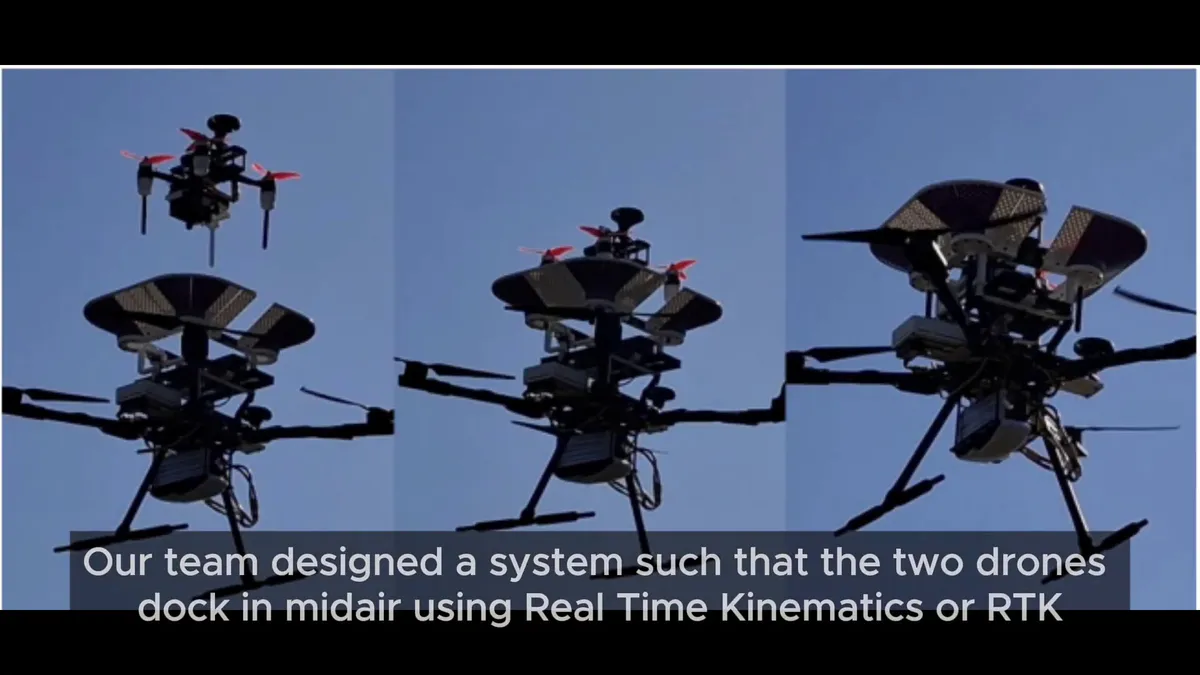
The two aircraft
Supplier
The approximately 680 mm quadrotor carries the spare battery, docking funnel, and belt-driven exchange module.
Receiver
The smaller QAV250 carries the battery interface. A backup battery keeps its electronics powered while the main pack is changed.
The experimental platforms needed reliable positioning and communication alongside the exchange hardware. I assembled, integrated, and maintained both multirotors, configured and tuned ArduPilot, and integrated RTK-GNSS positioning and MAVLink communication for the two-aircraft setup. I also prepared and operated the aircraft and troubleshot issues during outdoor tests.
At the rendezvous point, the receiver holds position. The supplier aligns underneath it and climbs into the docking interface. After contact is confirmed, a geared stepper motor drives parallel belts to remove the depleted battery and insert the charged one. The receiver then separates and resumes flight.
Outdoor results
- Docking
- 11 of 12 trials
- Battery exchange
- 11 of 11 successful dockings
- Exchange time
- About 8 seconds after docking
The team conducted these autonomous trials in steady winds of about 5–9 m/s, with occasional gusts up to 10 m/s. One docking attempt was aborted after wind drift caused lateral misalignment. The exchange result above is conditional on docking.
Publication
Yooseung Choi, Jamie Henson, Kai Xue Keller, Clifford Gamble, Abhishek Kini, and Ran Dai, “A Mid-Air Autonomous Battery Exchange Aerial System,” IEEE Robotics and Automation Letters, 11(7), 8108–8115, 2026. Accepted for presentation at IROS 2026.